Half a continent, facing the sea
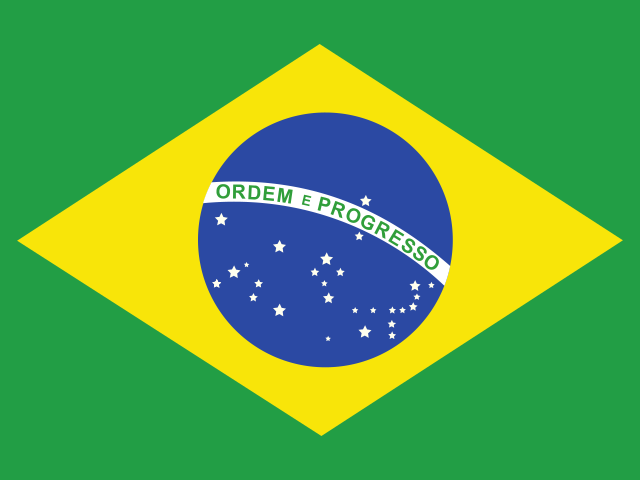
Brazil is the world's fifth-largest country. It covers roughly half of South America, touches every country on the continent except Chile and Ecuador, and is the only one in the Americas that speaks Portuguese. For all that land, its people still gather at the edge: the 2022 census found 54.8 percent of them living within 150 kilometres of the coast.
Behind them lies a very different country. The Amazon biome alone takes up 49.5 percent of the national territory. Even the highest point is deep in that remote north-west, on Yanomami land beside the Venezuelan border. Outsiders named it Pico da Neblina, the Yanomami call it Yaripo, and its height was overstated by about 20 metres until a GPS survey in 2004. The pull between the crowded shore and the vast interior runs through nearly everything that follows.
Sugar, gold and forced labour
When Pedro Álvares Cabral's fleet, bound for India, landed at Porto Seguro in 1500, millions of people already lived there. Nobody can know the exact number, though the British historian John Hemming cautiously put it at about 2.4 million. The newcomers saw them as a source of slaves from the start, and smallpox, measles and other imported diseases killed them in tens of thousands. Brazil's great size has a bitter origin in this: the hunt for Indigenous captives pulled raiders inland, past the treaty line dividing Portuguese claims from Spanish ones.
Sugar then demanded huge estates and ever more enslaved workers, and the colony turned to Africa. Brazil took more enslaved Africans than any other country. Emory University's slave trade database counts close to five million landed there, while only 3.6 percent of the whole trade reached North America. Gold, found in Minas Gerais in the 1690s, set off a rush that shifted people and wealth south and inland, and in 1763 Rio de Janeiro replaced Bahia as the seat of the viceroy.
Rio's Valongo Wharf shows how easily that history could be covered up. Between 500,000 and a million captives came ashore there from 1811 to 1831. A new wharf was laid over it in 1843 and buried in turn in 1911, until excavations in 2011 uncovered both, along with amulets linked to Congo, Angola and Mozambique. It has been a World Heritage Site since 2017. The Atlantic trade itself ended only in 1850, and on 13 May 1888 Brazil became the last country in the Americas to abolish slavery, through a law of just two articles signed by Princess Isabel.
An empire, a republic and a capital in the interior
Brazil's road to independence was unusual. When Napoleon's troops marched on Lisbon, the Portuguese court fled under British protection and settled in Rio in 1808, so that a colony found itself hosting its own monarchy. The king went home in 1821, leaving his son Pedro as regent. When the Cortes in Lisbon tried to return Brazil to colonial status, Pedro took Brazil's side and declared independence on 7 September 1822.
The new state was an empire, and its 1824 constitution ignored slavery. The monarchy outlasted abolition by only 18 months. Landowners' anger over emancipation hastened its end, and a military coup created the republic in 1889.
The capital moved inland again on 21 April 1960, when Brasília, conceived to open up the interior, replaced Rio. Built in 41 months, the city followed Lúcio Costa's aeroplane-shaped plan, with most of the public buildings by Oscar Niemeyer, and UNESCO listed it in 1987.
Four years after that inauguration, a coup began a military dictatorship that lasted until 1985. Brazil's National Truth Commission reported in 2014 that 434 people had been killed or disappeared, and that hundreds were tortured, though courts had read a 1979 amnesty as blocking prosecutions. It also documented Indigenous peoples driven off their land for infrastructure, mining and farming, and estimated that at least 8,350 Indigenous people were killed between 1946 and 1988, from only a limited number of cases. A new constitution followed in 1988, and direct presidential elections returned in 1989.
A country still counting itself
The 2022 census counted about 203 million Brazilians and showed the legacy of those centuries in its race figures. Pardo, or brown, was the largest group at 45.3 percent, ahead of white at 43.5 percent, the first time since 1991 that it had led. Indigenous people numbered 1.69 million, almost double the 2010 count. Officials credited this partly to teams reaching remote villages by helicopter and partly to more people feeling comfortable claiming that identity.
Soybeans show the scale of Brazilian farming: the country is the largest producer and exporter, with exports forecast in 2025 at more than double those of the United States. Income is far less evenly spread, and the World Bank reports that the top tenth of earners take 55 percent of it.
The interior remains the great unsettled question. Official monitoring estimated Amazon clearing at 3,335 square kilometres in figures released in October 2026, the lowest since the series began in 1988, yet the World Bank warns that the forest is nearing an ecological tipping point. Five centuries after those ships reached the shore, Brazil is still deciding what its vast inland is for.