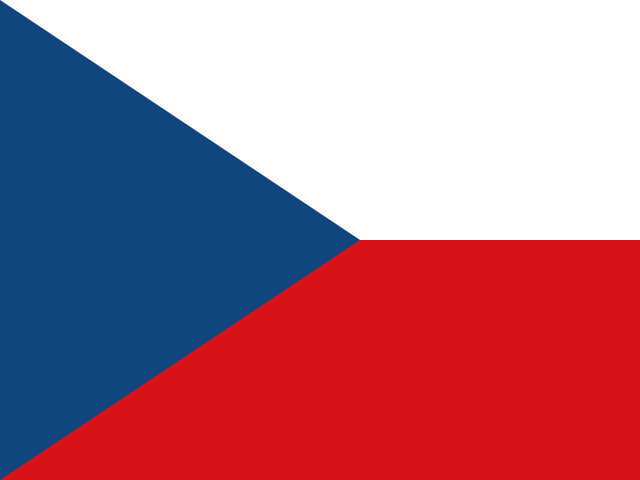
A green basin that drains to three seas
The Czech Republic joins two old lands. Bohemia, in the west, is a basin ringed mostly by low mountains and drained by the Elbe and the Vltava, while hillier Moravia to the east drains mainly through the Morava. Rain falling here can end up in the North Sea, the Baltic or the Black Sea, a remarkable reach for a landlocked country.
Very little of the land is truly high. Sněžka, in the Krkonoše range, stands just over 1,600 metres, and only about one percent of the territory rises above 1,000 metres. Forest covers roughly a third of the country, giving it a look of rolling hills and dark woods. The lowest ground, at 115 metres, lies where the Elbe leaves the country at Hřensko. Some three kilometres from that village stands Pravčická brána, the largest natural sandstone arch in Europe.
Warm water rises from below in the west. Karlovy Vary began as a small spa settlement around 1349 and took its name from Charles IV. It has more than 80 springs, the hottest approaching 73 °C, and since 2021 it has belonged to a UNESCO listing of Europe's great spa towns.
Pale lager, dumplings and the weekend cottage
Beer is the national pleasure. In 1842 the citizens of Plzeň hired a Bavarian brewer, Josef Groll, whose new beer was first poured that November. It was the world's first pale lager, and imitators soon borrowed the pilsner name. Kirin Holdings ranked Czechia first in the world for beer drunk per head in 2024, for the 32nd year running. Habits are shifting, though. Brewers reported a historic low of 121 litres a person in 2025, and barely more than a quarter of it was drunk in pubs and restaurants.
The food that goes with it is generous. Roast pork with dumplings and cabbage is often called the most typical Czech dish, and the bread dumplings are steamed and sliced like a loaf. Afternoon coffee brings koláče, soft yeast pastries filled with poppy seed, apricot or prune.
When the working week ends, the countryside calls. Cottages and cabins make up about a fifth of domestic buildings, and only four countries have more per person. The habit has two roots: the summer houses of wealthy city people and the interwar tramping movement of young workers who wanted freedom outdoors. Owners tend to refuse to sell, and the attachment extends to the land around them, with its mushroom picking and fishing.
Prague and a long road to the present
Prague, home to about 1.4 million people, sits on the Vltava, and its historic centre has been on the UNESCO list since 1992. Much of its shape dates from Bohemia's peak in the fourteenth century under Charles IV, who ordered the New Town and the Charles Bridge. He also founded a university in the late 1340s, which the Czech foreign ministry describes as Central Europe's first.
The reformer Jan Hus was burned as a heretic in 1415, and defeat at White Mountain in 1620 brought Habsburg rule and intense Catholicisation. Czechs and Slovaks declared a shared state in 1918. The Munich Conference of 1938 gave the Sudetenland to Germany, which took the rest in 1939. Nearly 74,000 Czech Jews were sent to the Terezín ghetto, and about four in five were deported onward, very few to survive. After the war, large numbers of Germans were expelled.
Communists took power in 1948, and the reforms of the Prague Spring ended with a Warsaw Pact invasion in August 1968. Protests that began on 17 November 1989 ended one-party rule in the non-violent Velvet Revolution. Czechoslovakia dissolved on 1 January 1993, and the Czech Republic joined the European Union in 2004 while keeping the koruna.
Robots, a difficult letter and carp in the bath
Czech is a West Slavic language, so close to Slovak that speakers largely understand each other. Its hallmark is ř, the sound in Dvořák, which falls somewhere between r and ž. The language also gave the world "robot", from robota, the forced labour of serfs. The word first reached the stage in Karel Čapek's play R.U.R. in January 1921, and Čapek credited his brother Josef with inventing it.
Czech ingenuity can be delightfully homespun. At Christmas 1961 the chemist Otto Wichterle made soft contact lenses on his kitchen table, using a children's construction kit and a son's bicycle dynamo. At the 1952 Olympics the runner Emil Zátopek won the 5,000 metres, the 10,000 metres and his first ever marathon, a treble nobody else has managed.
Old customs hold on with real charm. Around Pentecost, communities in the southeast stage the Ride of the Kings, in which a boy with a rose in his mouth is escorted on horseback while riders chant teasing rhymes at the crowd. Christmas dinner is carp with potato salad, and some families keep the live fish in the bathtub for a couple of days and then release it. A carp scale goes into the wallet for luck with money. On the tree hang ornaments of blown glass beads from the Giant and Jizera Mountains, made there since the late eighteenth century. And the good king of the English carol, Wenceslas, was a Czech too.