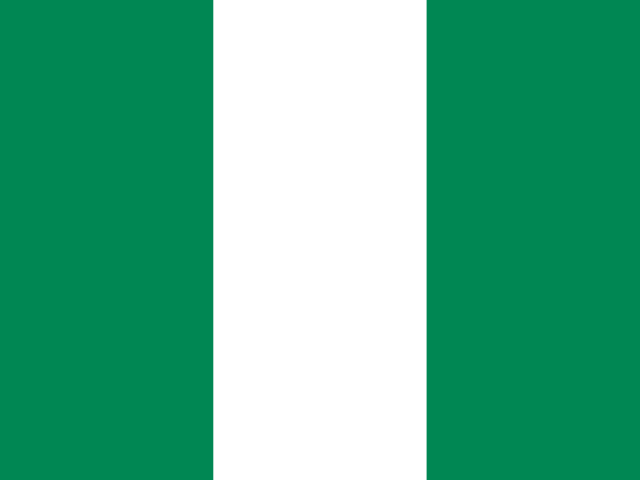
Named for a river, home to hundreds of peoples
Nigeria's name is a colonial invention: the British journalist Flora Shaw coined it in 1897, after the Niger. That river and its great partner, the Benue, converge and empty into the Niger Delta, and mangrove swamps fringe the Atlantic coast beyond. Rain is what divides the country from there. Much of the southeast receives 2,000 to 3,000 millimetres a year, while the north averages only 500 to 750 and knows the harmattan, a wind that carries fine dust down from the Sahara.
That long gradient holds more than 250 ethnic groups and some 500 languages, with English as the official tongue. The Hausa, Yoruba and Igbo together make up over 60 percent of the population, and the country divides roughly in half between Muslims and Christians, with Islam dominant across the northwest and northeast.
Older than the map
Art here runs far deeper than the state. Tin mining in the twentieth century brought to light the terracotta figures of the Nok culture, more than 2,000 years old and regarded as the earliest large figurative sculpture in Africa outside Egypt. Much later at Ife, which the Yoruba regard as the place where their deities created humans, artists cast strikingly lifelike heads in brass. In the north, a jihad that began in 1804 under Usman dan Fodio built the Sokoto Caliphate, which a Library of Congress study calls Africa's largest empire since Songhai fell in 1591.
The coast met a darker history. The same study says more than 3.5 million enslaved people were shipped from Nigeria to the Americas, most of them Igbo and Yoruba. In 1897 a British expedition looted the royal palace of Benin, the Edo kingdom, scattering its famous bronzes among foreign museums. Germany signed an accord in 2022 opening the way to return hundreds of pieces, though hundreds more were then still in the British Museum.
On 1 January 1914 Britain joined its northern and southern protectorates into one territory, yet it went on treating them differently. Rule ran through traditional leaders everywhere, but officials took careful account of Islam in the north, while in the south Christianity and Western education eroded the old rulers' religious standing.
Biafra and the long search for balance
Nigeria became independent on 1 October 1960 and a republic in 1963. In 1966 a January coup by junior officers was answered in July by a counter-coup of northern soldiers. Pogroms against Igbo people that year are estimated to have killed 10,000 to 30,000, and more than a million fled to the Eastern Region.
That region proclaimed itself the Republic of Biafra on 30 May 1967. Federal forces cut it off from the sea, famine took hold, and resistance collapsed in January 1970. The Library of Congress study puts deaths in the former region at 1 million to 3 million, and other estimates begin at 500,000. Biafra's leaders warned of genocide. International observers at the surrender reported no evidence of it, though much evidence of famine, and some scholars still argue that the charge holds.
Military governments followed, and in 1991 the capital moved from overcrowded Lagos to Abuja, at the country's midpoint and on ground considered neutral between the major groups. Stable democracy arrived only in 1999.
Violence has outlasted the generals. Boko Haram, founded in Maiduguri in 2002, took more than 200 schoolgirls from Chibok in 2014, and by 2018 a Council on Foreign Relations tracker linked it to more than 37,000 deaths. Herder-farmer clashes add to the toll, driven in large part by competition for land and water. Whether Christians are being singled out is fiercely argued, and Nigeria's government says both faiths suffer. Open Doors, which tracks persecution of Christians, reported 3,100 killed in a single year. ACLED, counting only deaths with a reported religious motive between 2020 and 2025, recorded 317 Christians and 417 Muslims.
The country that cannot count itself
Nigeria is Africa's most populous nation, though nobody knows quite how populous. Its last census, in 2006, found about 140 million people. The count planned for 2023 was postponed, and in early 2026 there was still no clear timetable. The stakes explain the difficulty: results shape political representation and the sharing of oil money, and earlier counts lost credibility in quarrels among the three largest groups. Lagos State disputed the 2006 tally of about 9 million for its metropolis, putting the figure nearer 16 million. The World Bank's 237 million for 2025 is therefore an estimate, not a headcount.
Oil remains the great prize, earning around 62 percent of export income in 2025, and the delta has paid for it. In 2011 the UN Environment Programme found families in one Ogoni community drinking well water with benzene over 900 times the World Health Organization guideline, and judged that recovery could take 25 to 30 years.
Nigeria's other great export is its culture. A UNESCO survey of 2006 output counted 872 Nigerian video productions, behind only India's output and ahead of America's major films. Many listeners hear the Afrobeat legend Fela Kuti in Burna Boy, who won a Grammy in 2021. A country unsure of its own numbers has no trouble making itself heard.