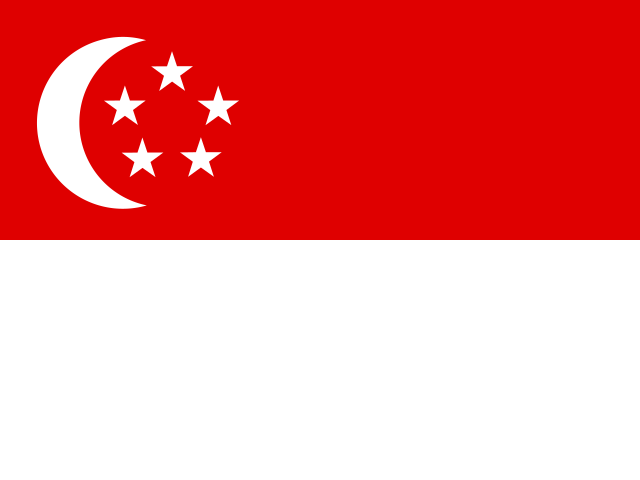
An island that keeps growing
Singapore lies about one degree of latitude north of the equator, off the southern tip of the Malay Peninsula: a main island with more than 60 smaller islands and islets around it. Land reclamation has carried the country from roughly 580 square kilometres in the 1960s to about 744 at the end of 2025.
The year has almost no seasons. Nights rarely fall below about 23 °C and days rarely climb past about 33 °C. Rain comes on some 171 days a year, and the weeks between the monsoons bring thunderstorms that tend to break in the afternoon or early evening.
All that heat and water makes things grow, and the city has leaned into the fact. Bukit Timah Hill, the highest point at about 164 metres, rises inside a reserve holding the island's largest unbroken stretch of primary rainforest, where colugos and pangolins still live. The Botanic Gardens, on their present site since 1859, led the research that helped make the region a great rubber producer, and they joined UNESCO's World Heritage List in 2015. At Gardens by the Bay the idea turns playful, with Supertrees up to 50 metres tall, clothed in orchids and ferns, lighting up to music every night.
Four languages and one long table
About 6.21 million people lived here in mid-2026. Roughly three in four residents are Chinese, with Malays and Indians the next largest groups. Malay is the national language, and it shares official status with English, Mandarin and Tamil. Home life has been shifting: English was the main language at home for 48.3 percent of residents in the 2020 census, up from 32.3 percent a decade earlier, though most of those people spoke a second language there too. Outside, many slide into Singlish, a contact language built on English with loanwords from Malay and Hokkien and a little Tamil. An official campaign launched in 2000 tried to discourage it, yet lah, kiasu and shiok have all reached the Oxford English Dictionary.
Faith is just as mixed. A 2014 Pew Research study gave Singapore the highest religious diversity score of 232 countries and territories, and the calendar shows it: Chinese New Year, Hari Raya Puasa, Vesak Day, Deepavali and Christmas are all public holidays.
Everything comes together over food. In the 1800s migrants from China, India, Malaysia and Indonesia brought their comfort dishes, adapted them to local ingredients and took to the streets, since hawking needed little capital. Between 1971 and 1986 the government set out to move up to 18,000 hawkers into markets and purpose-built centres, where people of every background now sit down together. UNESCO recognised hawker culture in 2020. One centre might offer satay grilled over charcoal, char kway teow and Hainanese chicken rice, widely considered the national dish, with frothy teh tarik poured back and forth between mugs.
Life in the high-rise heartlands
Most Singaporeans go home to a public flat. The Housing and Development Board was set up in February 1960 and had built more than 50,000 flats by 1965. Today about three in four residents live in its blocks, and since 1989 ethnic quotas have applied to each one to keep neighbours mixed. The open ground floors, known as void decks, work as a neighbourhood's spare room: a Malay wedding one weekend, a Chinese funeral the next, and card games and chatter in between.
In sport, Tan Howe Liang won the country's first Olympic medal, a silver at Rome in 1960, and Joseph Schooling its first gold, in the 100 metres butterfly at Rio in 2016.
A trading post with a long memory
Commerce here is far older than the modern city. By the fourteenth century the island, then known as Temasek, was already a centre of a wide trading network. Its later name, Singapura, comes from the Sanskrit for "lion city", and legend credits Sang Nila Utama with naming it after a beast he took for a lion, a tale historians still debate. Stamford Raffles landed in January 1819, and a treaty that February let the East India Company open a trading post. In 1826 Singapore joined Malacca and Penang in the Straits Settlements.
British forces surrendered to Japan on 15 February 1942. In the Sook Ching massacre that followed, ethnic Chinese people were killed in numbers estimated from about 5,000 to the tens of thousands. Japan surrendered in 1945. A union with Malaysia began in September 1963 and lasted under two years: on 9 August 1965 Singapore was proclaimed an independent republic, and that date is still National Day.
Trade remains the heartbeat, with a record 44.66 million twenty-foot container units handled in 2025. Water has demanded as much ingenuity. Alongside supplies from Johor, Singapore now collects its own rain, desalinates seawater and purifies used water into NEWater.
Cleaning up the waterways brought a happy reward. Smooth-coated otters had nearly disappeared in the 1970s and 1980s, but a resident family was seen in 1998, and by early 2021 there were at least 170. They now cross roads between canals and reservoirs, and pups have been raised in the ponds of the Botanic Gardens, small wild neighbours who moved back in once the city made room.