A landmass that ran into Asia
India's geography begins with a slow collision. Some 80 million years ago India was travelling north towards Asia at between 9 and 16 centimetres a year, and around 50 million years ago the two began to meet. The drift slowed but never stopped, and the Himalayas, pushed up along the join, are still rising as erosion wears them down. The range curves for about 2,400 kilometres between the plains of the subcontinent and the Tibetan Plateau, and the Indus, the Ganges and the Brahmaputra all rise close to it.
South of those mountains, a single season rules the year. Between June and September the southwest monsoon delivers roughly 70 to 75 percent of the country's annual rain.
Cities, emperors and a company
Town life here is very old. The Indus civilisation reached its mature phase around 2600 BCE and spread across parts of present-day Pakistan, northwestern India and Afghanistan. Places such as Harappa and Dholavira were laid out to a plan, built of baked brick and served by covered street drains, yet their script remains undeciphered. The subcontinent went on to give the world Hinduism, Buddhism, Jainism and Sikhism.
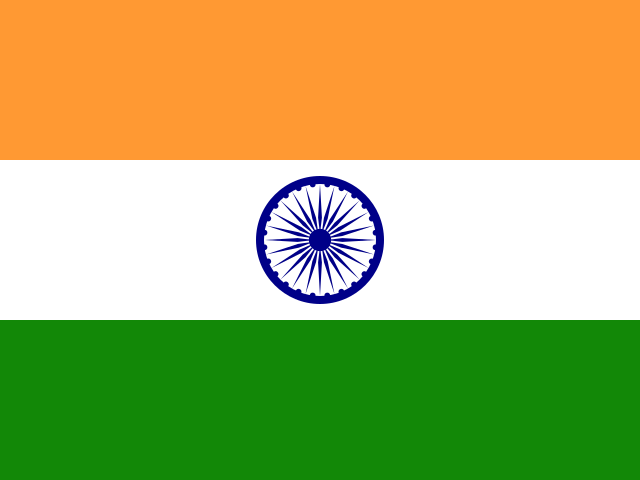
One ancient ruler still marks the national symbols. In the third century BCE the Mauryan emperor Ashoka conquered Kalinga, and his own rock inscription counts 100,000 killed and 150,000 taken captive before recording his remorse. He turned to a moral code he called dhamma and helped carry Buddhism across Asia. India's state emblem adapts his lion capital, and his wheel sits at the centre of the national flag.
Babur's victory at Panipat in 1526 is the conventional founding of the Mughal Empire, which reached its greatest extent under Aurangzeb and then sank into feuding. That weakness served a London trading firm. The East India Company, chartered in 1600, won at Plassey in 1757 and in 1765 received the right to collect the revenues of Bengal, Bihar and Orissa from the Mughal emperor himself. Merchants had become a government, until the rebellion of 1857 led Britain to end Company rule and take direct control.
Resistance became a mass movement. In 1930 Gandhi walked to the sea at Dandi to defy the British monopoly on salt, and about 60,000 people were jailed by the end of that year. Its last years brought catastrophe. In the Bengal famine of 1943, an estimated 800,000 to 3.8 million people died, as lost Burmese rice imports, wartime inflation, British policy and a ruined harvest combined. How much each factor mattered is still debated.
Freedom and division
Independence came on 15 August 1947, with partition. Punjab and Bengal were divided according to Muslim and non-Muslim majorities, by Cyril Radcliffe, a lawyer appointed by Britain, who had never visited India and was given five weeks. His line was published two days after independence. About 15 million people were displaced, and estimates of the dead run from 200,000 to two million.
Kashmir became the lasting wound. Its ruler signed accession to India in October 1947, war followed, and a ceasefire line later became the Line of Control. India claims the whole former princely state on the basis of that accession, Pakistan claims most of it on the basis of its Muslim majority, and China holds Aksai Chin. War returned in 1965, in 1971, when fighting helped create Bangladesh, and at Kargil in 1999. In August 2019 India revoked the region's special constitutional status, a move Pakistan viewed as a grave injustice, and a deadly attack on tourists in April 2025 led to Indian strikes the following month before a ceasefire took hold.
The republic's constitution, drafted by a committee under B. R. Ambedkar, took effect on 26 January 1950, still celebrated as Republic Day. It abolished untouchability and made enforcing it a punishable offence.
The people, the count and the rain
The United Nations estimated that India passed China as the most populous country around April 2023, while warning that the date was approximate. The last census had been taken in 2011. The next population count is scheduled for February 2027 and will record caste, last counted comprehensively under the British.
The Constitution names no national language. Hindi and English serve the central government, 22 languages are listed in its Eighth Schedule, and Hindi was the first language of about 43.6 percent of people in 2011. That census counted 79.8 percent as Hindu and 14.2 percent as Muslim. Democracy works at matching scale: the 2024 general election had almost 980 million registered electors and about 646 million votes.
The economy changed course in 1991, when foreign reserves fell to about three weeks of imports and the government scrapped most industrial licensing. The World Bank says the economy has nearly quadrupled in real terms since 2000, and extreme poverty fell from 16.2 percent in 2011-12 to 2.3 percent in 2022-23. In August 2023 Chandrayaan-3 made the first soft landing near the Moon's south pole, four years after its predecessor crashed.
Even so, nearly 45 percent of India's sown land has no irrigation and relies entirely on the rains. A country that can land a spacecraft on the Moon still looks to the sky each June.